Turbines, Rotary Engines, and Speculative Concept Powertrains
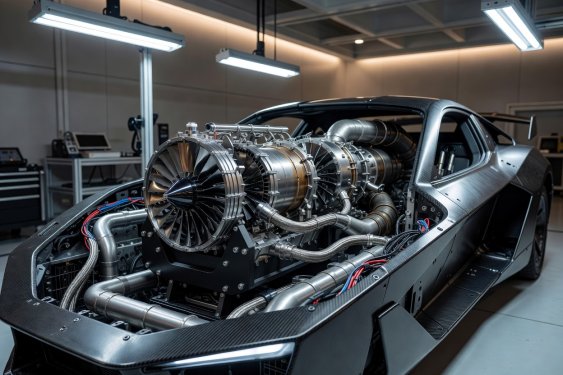
The internal combustion reciprocating piston engine has dominated personal transit for over a century, but its status was challenged repeatedly by engineers looking for higher energy density, lower vibration harmonics, or simplified moving parts. Concept cars served as the proving grounds for engines that completely abandoned four-stroke reciprocating architecture.
The Gas Turbine Automobile Experiments
Following the rapid maturation of jet engines during World War II, major manufacturers invested millions in adapting centrifugal compressors and axial power turbines to road chassis. The Chrysler Turbine Car of 1963 was the most famous near-production study, but styling houses pushed the envelope into wilder forms.
The 1954 Fiat Turbina was engineered purely as an aerodynamic and thermodynamic test platform. Featuring two compressors and a single-stage power turbine running at 22,000 RPM, the Turbina produced approximately 300 horsepower with no clutch or geared transmission. Because the turbine delivered continuous torque via fluid-dynamic gas transfer, acceleration was remarkably smooth, though exhaust temperatures exceeded 400 degrees Celsius and thermal lag prevented rapid throttle response.
Multi-Rotor Wankel Platforms
The rotary engine pioneered by Felix Wankel offered an unmatched power-to-weight ratio and compact packaging, leading design studios to construct mid-engine prototypes around multi-rotor units.
The Mercedes-Benz C111-II concept of 1970 served as the pinnacle of rotary vehicle testing. Equipped with a four-rotor direct-injection Wankel engine (DB M950 KE409), the engine produced 350 horsepower from a displacement equivalent of only 2.4 liters. It propelled the gullwing test car to 300 km/h with an engine redline surpassing 7,000 RPM. Despite exceptional performance and silky power delivery, high hydrocarbon emissions and rapid apex-seal wear during cold starts ultimately caused Daimler to shelve the project in favor of turbocharged diesel research.
Transverse Multi-Cylinder Curiosities
When concept cars retained piston engines, they frequently packaged them in unusual orientations to suit low bodywork.
| Engine Type | Notable Prototype | Displacement | Packaging Benefit |
|---|---|---|---|
| Twin-Regenerative Gas Turbine | Chrysler Turbine Ghia (1963) | Equivalent 130 hp | 80% fewer moving parts, multi-fuel capability |
| Four-Rotor Wankel Rotary | Mercedes-Benz C111-II (1970) | 4 x 600cc chambers | Ultra-low center of gravity, zero piston vibration |
| Transverse Quad-Turbo V16 | Cizeta-Moroder V16T (1991) | 6.0 Liters | Extremely short engine bay length behind seats |
| Rear Radial Aircraft Piston | FASV Aero Car Concept (1951) | 3.8 Liters | Air-cooled direct prop drive conversion study |
Legacy of Experimental Powertrains
While the gas turbine and large multi-rotor engines were largely discarded due to fuel consumption spikes and emission stringencies, the compact packaging lessons learned in these test programs influenced modern electric skateboard platforms. Today’s dual-motor electric concept cars achieve the exact low center-of-gravity and flat cabin floor that 20th-century prototype builders dreamed of with turbine and rotary machinery.