Bespoke Structural Coachwork and Composite Prototype Shells
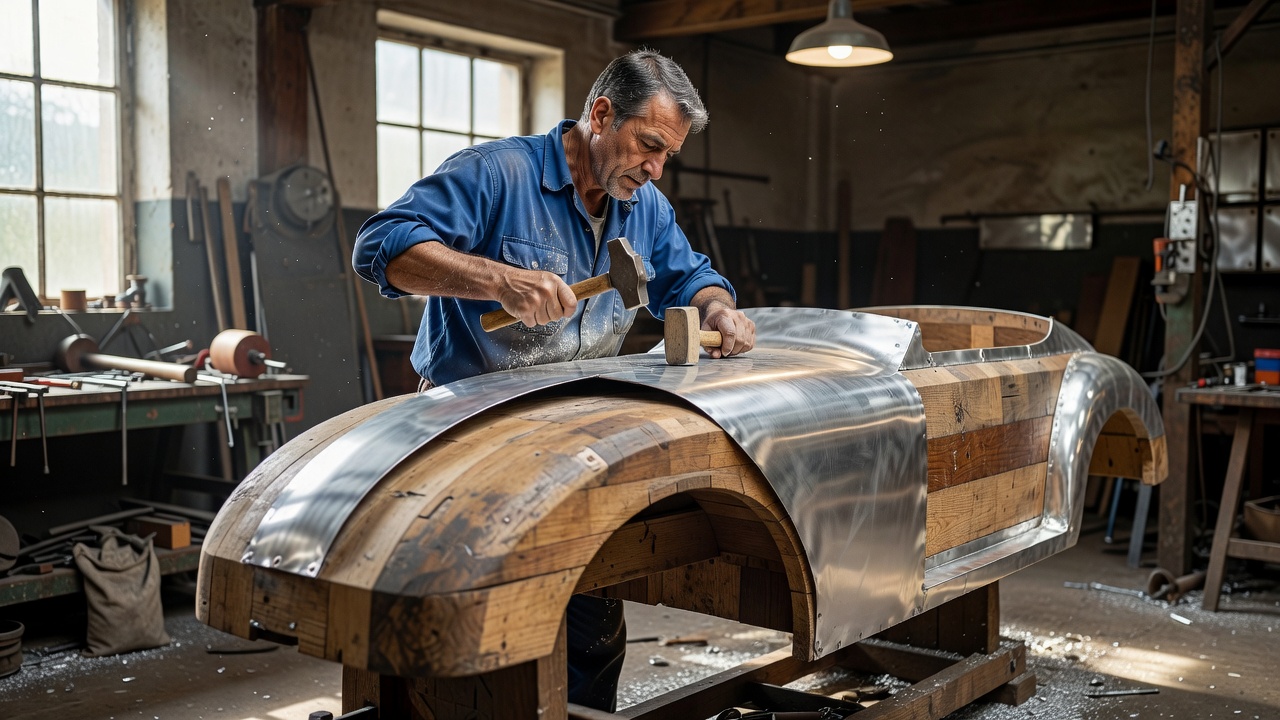
Before stamped steel presses established the economies of scale for mass transit, automobile manufacturing was an offshoot of luxury carriage craft. Even as automated spot-welding came to dominate assembly lines, the styling atelier preserved traditional artisanal panel-beating, evolving it to master lightweight titanium, glass-reinforced plastic, and autoclave-cured carbon composites.
The Wooden Buck and the English Wheel
The construction of a bespoke concept vehicle traditionally began not with steel dies, but with full-scale wooden models called bucks. Master sculptors formed cross-sectional ribs from seasoned mahogany or ash, reproducing full-size plans drawn on drafting paper.
Sheet aluminum—frequently aerospace-grade Superform or temper alloys—was subsequently beaten with rawhide mallets into sandbags, then hand-rolled across an English wheel to eliminate hammer indentations and work-harden the compound curves. This manual technique enabled designers to produce creases, complex negative curvature valleys, and compound fillets that contemporary automated stamping presses could not press without tearing sheet metal.
The Fiberglass and Resin Revolution
During the 1950s and 1960s, glass-reinforced plastic (GRP) emerged as a quick, flexible alternative to sheet metal for experimental prototypes. GRP eliminated the necessity of expensive tool tooling investments.
Designers could sculpt a concept in automotive styling clay, cast a negative female plaster mold directly over the clay surface, and lay down woven fiberglass cloth infused with polyester or epoxy resin. The 1953 Chevrolet Corvette owes its existence to this exact prototyping workflow, as did European studies like the 1965 Matra Djet and the iconic 1970 Lancia Stratos prototypes. Fiberglass allowed for rapid revisions, but its thermal expansion mismatch with metal chassis frames often led to surface distortion under show lighting.
Structural Carbon Fiber and Monocoque Envelopes
By the late 1980s, experimental ateliers discarded fiberglass in favor of pre-impregnated carbon fiber cloth and Nomex honeycomb cores. Instead of treating body panels as passive cosmetic shells hung over a steel spaceframe, the skin became the primary load-bearing structural chassis.
The 1986 Jaguar XJ220 prototype and the 1991 Audi Avus quattro showcased contrasting extremes of coachwork philosophy: the Jaguar utilized bonded alloy honeycomb, while the Avus used an unpainted, mirror-polished aluminum skin over a spaceframe skeleton. These coachbuilding projects demonstrated that vehicle styling and chassis engineering could function as a unified structural sculpture.