Experimental Cockpits, Flight Controls, and Canopy Architectures
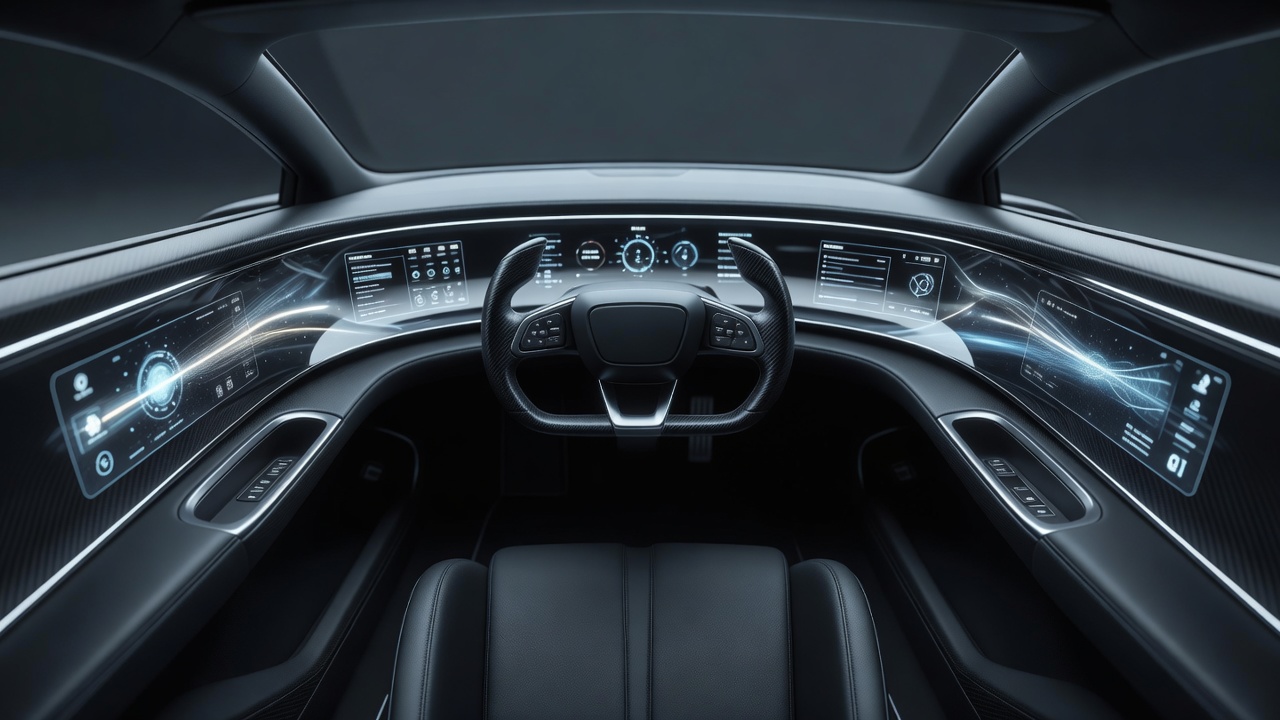
Inside an experimental concept car, ergonomics ceases to be a conservative study of commuter convenience and transforms into a high-risk laboratory for human-machine interaction. Free from the mandate of dual-airbag steering columns, child-seat tethers, and standardized blinker stalks, prototype interiors have borrowed heavily from supersonic aviation, naval submarines, and speculative computing.
Canopy Access: The Rejection of Side Doors
The standard passenger car side door requires heavy internal crash beams, hinges, weather seals, and lock assemblies. Concept cars from the 1960s and 1970s often bypassed these engineering compromises by treating the greenhouse as an articulated fighter aircraft canopy.
The 1970 Ferrari Modulo, styled by Paolo Martin at Pininfarina, mounted its entire roof, windscreen, and side glass assembly on forward-sliding linear rails. To enter, the driver pushed the glass forward, stepped over deep sill ledges, and reclined into deeply sculptured bucket seats. Similarly, the Holden Hurricane concept used an electro-hydraulic clamshell that lifted the roof upward while simultaneously raising the steering column and lifting the seat bases to ease ingress.
Center-Seat Monocoques and Weight Centering
The layout of traditional automobiles positions the operator off-center, requiring balance compensation via fuel tank placement or suspension spring rates. Designers seeking absolute dynamic symmetry frequently positioned the driver on the vehicle's exact centerline.
Decades before the McLaren F1 popularized the three-abreast central cockpit on a road-legal vehicle, concepts like the 1966 Bizzarrini 5300 GT Duca d'Aosta and the 1972 Maserati Boomerang explored centralized driver placement. The Boomerang took this radical geometry further by integrating the entire gauge cluster—including speedometer, tachometer, and warning lights—inside the stationary hub of an oversized steering wheel, surrounded by the rotating rim.
The Cathode-Ray and Digital Switchgear Revolution
During the late 1970s and 1980s, automotive designers attempted to eliminate mechanical needle gauges in favor of green phosphor cathode-ray tubes (CRTs), vacuum fluorescent displays (VFDs), and membrane switches.
- Aston Martin Bulldog (1979): Featured a full digital touch-button control panel mounted to the left of the central spine, completely devoid of mechanical knobs.
- Citroën Karin (1980): Arranged switchgear on a central triangular pyramid pointing directly at the driver, placing lights, wipers, and horn within immediate fingertip reach without taking hands off the wheel.
- Italdesign Orca (1982): Mounted LCD telemetry matrices onto the steering wheel face, introducing steering-mounted audio and climate controls long before steering wheel hubs became universal.
Ergonomic Failures and Production Realities
While concept cockpits generated astonishing auto-show imagery, many were functionally disastrous in real-world road trials. Forward-tilting canopies turned vehicle cabins into greenhouse heat traps when stopped under direct sunlight, and early CRT panels washed out completely in ambient daylight. However, the conceptual drive toward heads-up displays, consolidated multifunction wheels, and digital telemetry directly laid the groundwork for contemporary glass-cockpit road cars.